
AIS vessel tracking
AIS vessel tracking for fishing
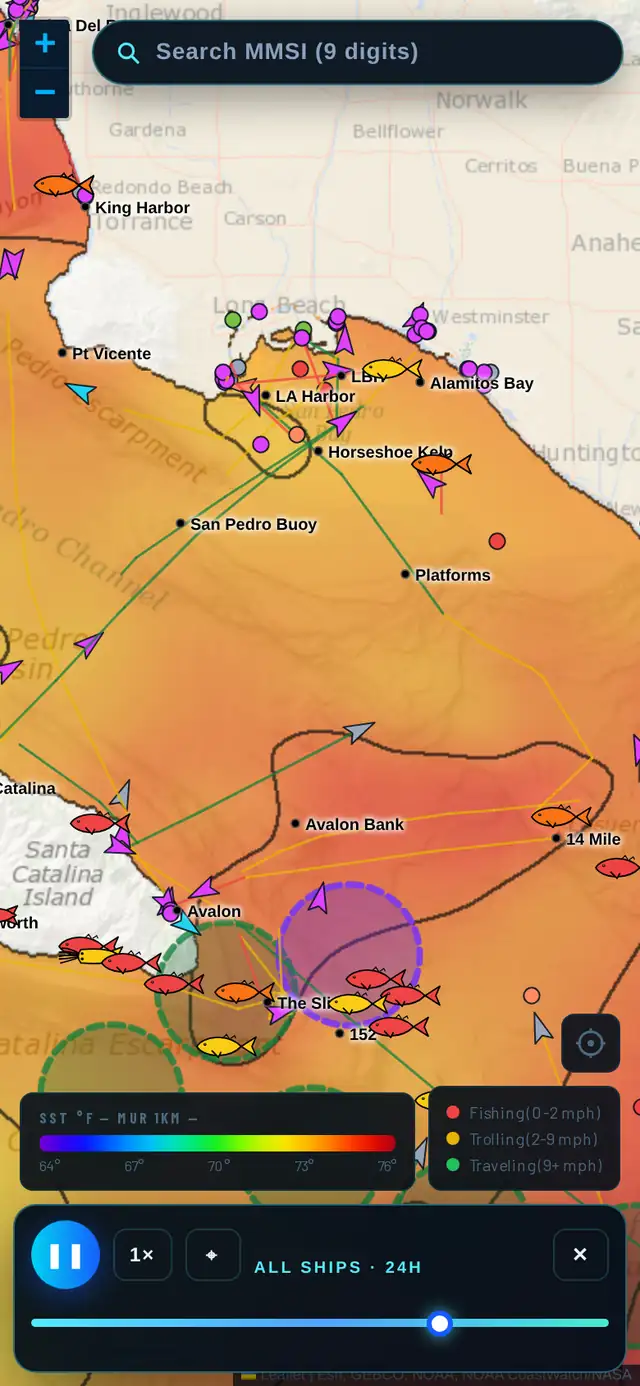
The working boats already found the fish. If working boats are stacked on a spot, they're on something. Catalysst shows live AIS vessel positions plus 72-hour playback, turning 'where is everyone?' into 'where should I be?'
What is AIS, and how does it help you find fish?
AIS (Automatic Identification System) is a transponder system: a boat broadcasts its position, speed, and course. Commercial ships carry it, and many larger sportfishing and recreational boats do too — not every boat. Catalysst shows live AIS in your view, by name, color-coded by speed, with a 72-hour trail.
You're not just seeing boats — you're reading intent. A group of boats holding on a spot right now is a strong hint that something is there.
The three vessel behaviors that signal fishing
Slow-speed clusters: multiple boats holding under 2 knots in a tight area means they're drifting bait or anchored on a school. Tight 180°-plus turns: usually a hookup, a bait ball, or a boat working a school. Returning boats: the same vessel coming back to the same coordinates over multiple days is a captain who knows that spot is producing.
Catalysst color-codes vessels by speed so the slow clusters jump out, and the trails make the turns obvious at a glance.
72-hour playback: read where the fleet has been
Scrub backwards through the last three days. Watch how the fleet drifted, where boats spent the most time, and where clusters formed at sunset and broke up at sunrise. That tells you where bait held overnight — and bait that held last night is usually still close enough to be worth a look this morning.
Watch lists
Build a watch list of up to 50 vessels — the captains you follow and the boats you trust — so they stand out on the chart.
Frequently asked
Can you track fishing boats with AIS?
Yes. AIS broadcasts position, speed, and course for commercial vessels and many larger recreational boats. Catalysst shows live AIS in your view, color-coded by speed, with a 72-hour trail — so you can see where the working boats are now and where they've been.
What vessel behavior means the fish are biting?
Slow-speed clusters (boats under 2 knots packed tight = drifting on a school), tight 180°+ turns (hookups or working bait), and the same boat returning to a spot over multiple days (a captain who knows it's producing).
Can I follow specific boats?
Yes — in the US and International editions you can build a watch list of up to 50 vessels so they stand out on the chart.
See it in the app
7-day free trial. Plan your next trip from the dock.